
Employees routinely travel between Derry, Strabane and Donegal, while businesses recruit, trade and invest across both jurisdictions. Yet the systems governing taxation, payroll and immigration continue to treat cross-border employment as an exceptional arrangement.
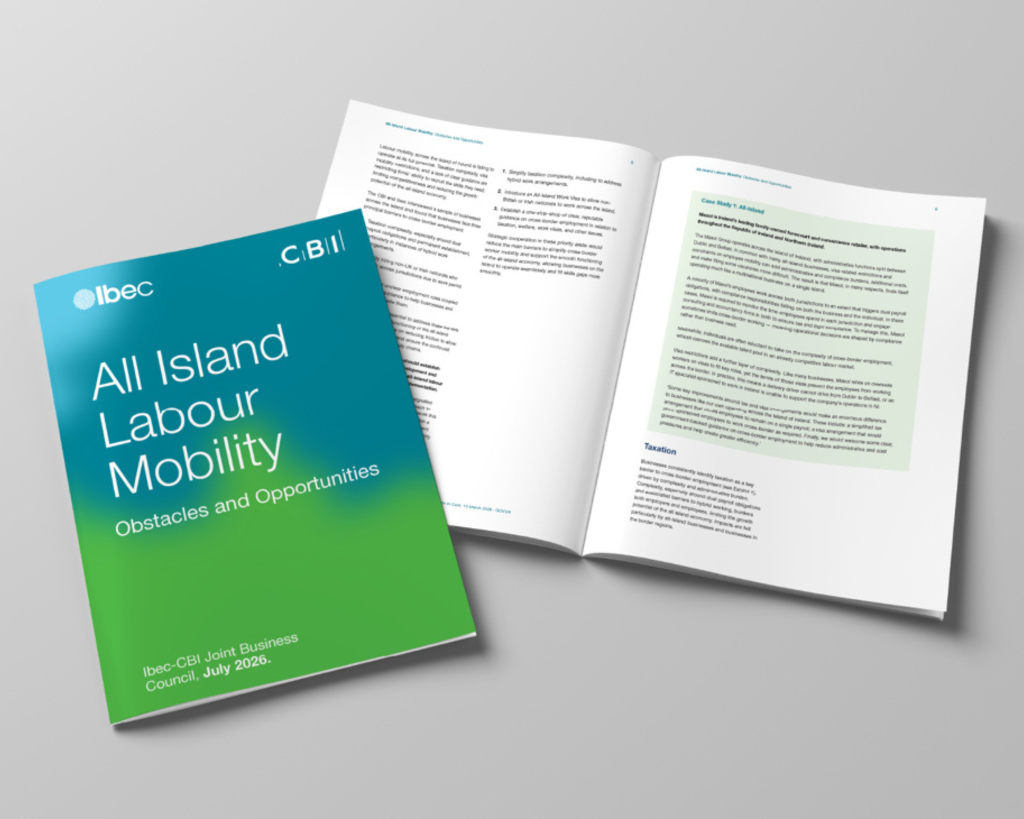
A new report from the Ibec–CBI Joint Business Council demonstrates the consequences. All-Island Labour Mobility: Obstacles and Opportunities finds that taxation complexity, restrictions affecting sponsored workers and a lack of clear guidance are limiting recruitment, hybrid working and business growth.
The report estimates that approximately 18,000 people work across the border, although it acknowledges that the true figure is likely to be higher. Its findings are particularly relevant to the North West, where access to workers on both sides of the border is essential to the region’s competitiveness.
One case study examines a Donegal technology company that had previously employed 60-70 cross-border workers, including people from Derry. As hybrid working increased the company’s tax and compliance risks, it stopped recruiting Northern Ireland residents. This reduced its access to the wider North West talent pool and weakened Donegal’s competitiveness as a location for further investment.
These findings reinforce what Londonderry Chamber and our partners in Letterkenny Chamber have consistently raised with political representatives across Northern Ireland, Great Britain and the Republic of Ireland.
Earlier this year, the two Chambers appeared before the Oireachtas Joint Committee on the Implementation of the Good Friday Agreement, highlighting labour mobility alongside infrastructure, skills and balanced regional development. Chamber representatives have also raised practical barriers with Pádraig Mac Lochlainn TD, Banking and Payments Federation of Ireland, John Burrows MLA, Diane Forsyth MLA, Charlie McConalogue TD and, most recently, the First Minister and deputy First Minister.
Across these engagements, our message has been consistent: the North West is a shared labour market, but workers and employers face avoidable complications involving taxation, pensions, social security, mortgages, visas, employment law and hybrid working.
Londonderry Chamber fully supports the report’s three principal proposals
- simplifying taxation for cross-border and hybrid workers
- developing an All-Island Work Visa for eligible workers who are neither British nor Irish citizens
- establishing a trusted one-stop shop providing clear guidance to employers and employees.
We particularly support the call for the UK and Irish governments to establish a joint forum, involving business representatives, with clear timescales for delivery. This closely reflects the Chamber’s call for a practical cross-border working mechanism capable of turning longstanding concerns into agreed reforms.
The issue has been recognised for long enough. Similar barriers were identified by the North South Ministerial Council 25 years ago, while the UK and Irish governments have now committed to considering a bilateral approach.
The North West already works across the border. The task now is to ensure that taxation, immigration and employment systems allow its people and businesses to do so without unnecessary cost or complexity.
You can read the full report here: All Island Labour Mobility – Obstacles and Opportunities
Londonderry Chamber
CONNECTING
BUSINESS
NORTHWEST