
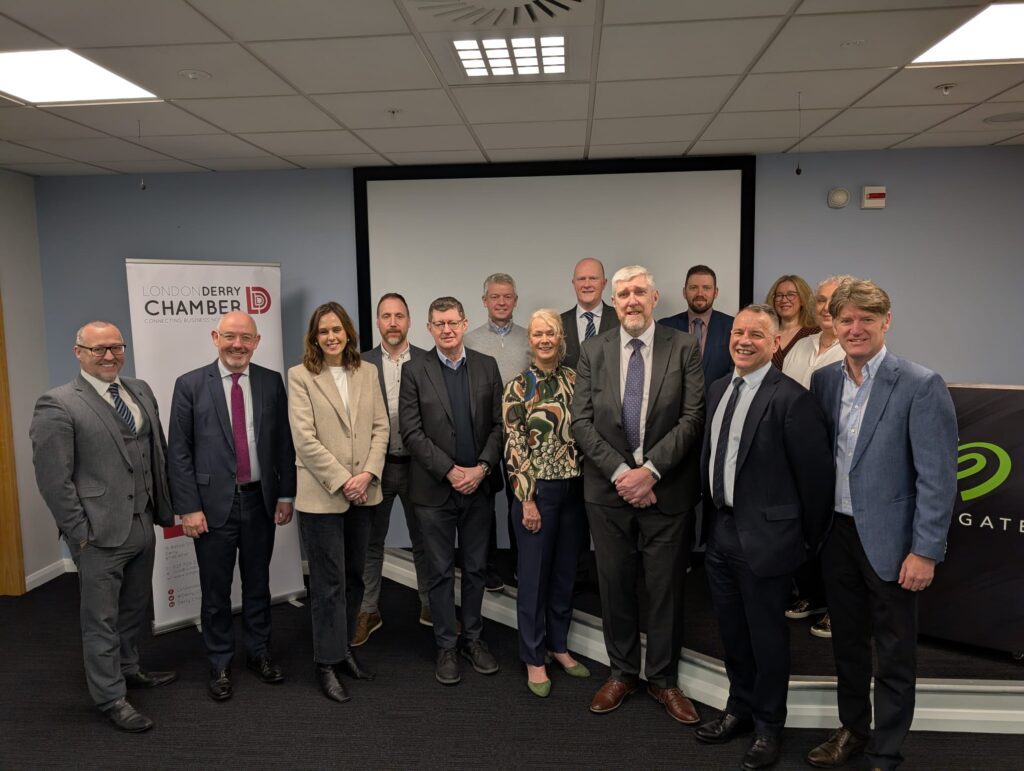
Senior representatives from the Chamber, our corporate sponsors, held a private engagement with John O’Dowd to examine issues that are affecting the business community in the North West.
On the Draft Budget, the Minster outlined the complexity of securing Executive agreement but emphasised all departments are working collaboratively to agree on a multi-year budget. Departments have been tasked to reassess expenditure, so the public purse is spent effectively and efficiently. This is essential for the NW and NI as whole to provide certainty for infrastructure, skills and investment.
For the North West, discussion focused on regional balance and delivery risk. The Programme for Government objectives for regional balance was acknowledged, the Chamber emphasised the need to ensure momentum continues in the delivery for Magee expansion. The student numbers are above targets at 6,500, but work is still needed to achieve the 10,000 places committed within the Programme for Government. The Chamber discussed the strategic importance of the university in the region but stressed that targets are financially vulnerable amid tightening budgets. Cross departmental collaboration and ringfencing mechanisms were discussed as safeguards.
The decision to reverse Reval 2026 was welcomed by the Chamber. This had a profound effect on members and the wider business community in the North West. Whilst the Chamber understands that fiscal devolution is limited and business rates are still to be finalised, we discussed a pilot VAT reduction (equivalent to the Republic of Ireland) or NIC reduction.
Infrastructure constraints with delays in the A2 and A5, wastewater capacity and planning reform were acknowledged. The Minister focused on supporting the Department for Infrastructure in housing delivery, progressing the Sustainable Drainage System bill and called for localised environmental solutions for localised challenges. City Deal Projects have entered into the delivery phase, and the Chamber expressed the need for a coordinated effort to ensure these projects are delivered with minimal disruption as possible.
Finally, skills were addressed as a key enabler for the growth in the North West region. Improving the quality as well as quantity of jobs in the North West are equally important. Businesses in the North West have already implemented AI into the organisations and have used it to reengineer their processes. By using AI, the region can focus on being more innovative. However, due to limitations in cross-border mobility, the talent pool has been tightened since Covid. Further to this, to ensure AI is adopted calls were made to ensure there is a governance framework that supports ethical and efficient adoption. This work is currently being progressed by Stormont’s AI APG.
In concluding, the Minister stated that the era of the North West being overlooked is over. While acknowledging that further progress is required, he pointed to visible momentum across infrastructure, City Deal delivery and university expansion as evidence of renewed Executive focus. That shift, he suggested, is beginning to strengthen business confidence in the region and reinforce the North West’s position as a credible location for sustained investment and growth.
Takeaway:
The North West’s economic trajectory hinges less on ambition and more on protecting funding, infrastructure acceleration, AI adoption and disciplined delivery.
Londonderry Chamber
CONNECTING
BUSINESS
NORTHWEST